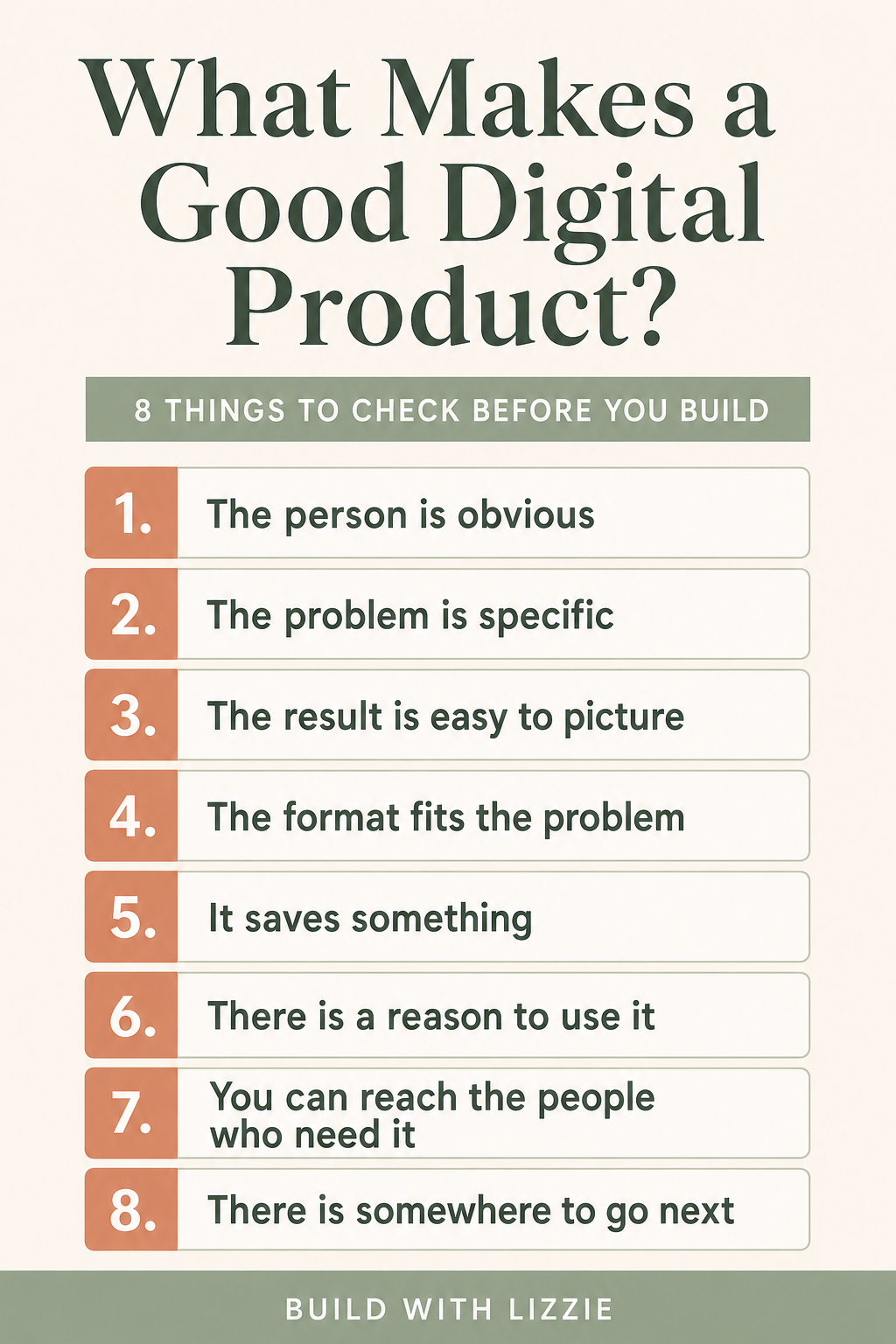
8 Signs You Have a Good Digital Product Idea
When I first started thinking about digital products, I found it very easy to judge ideas by the wrong things.
I would think:
- this would look nice
- I could make this quickly
- people seem to sell things like this
- I could probably make it with AI
But none of those automatically mean the product is actually useful.
Now, I think a much better question is:
Would this make something easier, clearer, faster, cheaper or less stressful for a specific person?
That is what I would check before spending hours building anything.
Here are the eight things I would look at first.
1. The Person Is Obvious
A strong digital product should make the right person think:
“Oh, this is for me.”
Compare:
Too broad: Productivity Planner
More specific: Weekly Planning System for Freelancers Managing Multiple Clients
Or:
Too broad: Meal Planner
More specific: 15-Minute Weeknight Meal Planner for Busy Parents
You do not need the smallest niche in the world. You just need enough specificity that the buyer recognises themselves.
Ask:
- Who is this for?
- What situation are they in?
- Would they immediately understand why it relates to them?
2. The Problem Is Specific
“Get organised” is not a very clear problem.
“Keep forgetting which invoices need chasing” is.
“Budget better” is vague.
“Compare two wedding venue packages and see which actually costs less” is much clearer.
Specific problems are easier to solve and much easier to market.
Try asking:
- What keeps going wrong?
- What are they forgetting?
- What decision are they struggling with?
- What takes too long?
- What feels confusing?
The more concrete the problem, the easier it becomes to build something useful.
3. The Result Is Easy to Picture
People do not really buy spreadsheets, planners or PDFs.
They buy the result those things help create.
A useful result might be:
- know how much money is left
- choose between two options
- stop missing payment dates
- plan the next four weeks
- price a product properly
- know what task needs attention next
“Feel more productive” is difficult to picture.
“Know what to work on first every Monday morning” is much easier.
Ask yourself:
What will the person know, decide or complete after using this?
4. The Format Fits the Problem
This is one of the biggest things I would check.
Do not make an ebook just because ebooks are easy to create.
Match the format to the job.
If someone needs to:
- remember something → checklist
- reuse something → template
- plan over time → planner
- monitor progress → tracker
- work something out → calculator
- think through a decision → workbook
- solve several related tasks → resource kit
Sometimes a one-page checklist is more useful than a 40-page guide.
That is completely fine.
5. It Saves Something
A good digital product normally saves at least one of these:
- time
- effort
- money
- confusion
- mistakes
- uncertainty
- mental load
For example, a client onboarding checklist might save time and prevent mistakes.
A pricing calculator could reduce uncertainty.
A travel planner might reduce mental load.
If you cannot explain what the product makes easier, it may need more work.
6. There Is a Reason to Use It
This is especially important now that AI can generate so much content quickly.
Ask:
Why would somebody use this instead of making their own blank spreadsheet or asking ChatGPT?
The value might come from:
- good structure
- niche-specific examples
- formulas
- automation
- scoring
- comparisons
- saved setup time
- a clear workflow
- useful decisions built into the tool
AI can help you create the product faster.
But “AI made it” is not the value of the product.
The value is what it helps the customer do.
7. You Can Reach the People Who Need It
A genuinely useful product can still be difficult to sell if you have no idea where the audience is.
Think about where they already look for help.
Could you find them through:
- YouTube
- Facebook groups
- Etsy searches
- niche communities
And search for the problem, not just the product.
For example, instead of only searching:
wedding budget spreadsheet
look for things like:
how to compare wedding venue packages
or:
why is my wedding going over budget
You are looking for evidence that people actually care about the problem.
8. There Is Somewhere to Go Next
You do not need a huge sales funnel before you begin.
But I like product ideas that naturally lead somewhere.
For example:
Free checklist
→ paid planner
Simple tracker
→ advanced dashboard
Free calculator
→ complete planning system
Template
→ resource kit
A useful question is:
If somebody loved this, what would they need help with next?
That can tell you whether the idea has room to grow.
A Simple Digital Product Scorecard
Give your idea a score from 1 to 5 for each:
- Is the audience clear?
- Is the problem specific?
- Is the result visible?
- Does the format fit?
- Does it save something meaningful?
- Is there a reason to use this instead of DIY?
- Can I reach the audience?
- Is there a logical next step?
Total: /40
I would not treat the score as proof that something will sell.
It is simply a way to spot where an idea is still fuzzy before you spend hours building it.
The One-Sentence Test
Try finishing this sentence:
This product helps [specific person] who struggles with [specific problem] to [useful result] using [format or mechanism].
For example:
This spreadsheet helps freelance photographers who struggle to price jobs consistently calculate a minimum profitable project price using their costs, hours and desired margin.
If you can explain the product that clearly, you probably have something worth investigating.
If you cannot, that does not mean the idea is bad.
It usually means it needs sharpening.
Still Looking for the Right Idea?
If you are not at the “is this a good idea?” stage yet and you are still thinking:
What should I actually create?
I made a free workbook with 100 Digital Product Ideas You Can Create With AI.
It includes ideas across lots of niches and formats, plus space to shortlist the ones that fit you best.
You definitely do not need to make all 100.
You only need to find one idea worth exploring.