What Digital Product Should I Sell? 7 Questions to Help You Choose
If you are asking “What digital product should I sell?”, there is a good chance the problem is not that you have no ideas.
It might actually be the opposite.
There are almost too many.
You could make a planner. A spreadsheet. A Canva template. A workbook. A calculator. An ebook. A prompt pack. A tracker. A database. A toolkit.
Then you open Pinterest, TikTok or Etsy and find another 50 suggestions.
Suddenly you are not choosing between two ideas. You are choosing between hundreds.
I have been running into this myself while building Build with Lizzie.
AI has made generating ideas almost ridiculously easy. I can ask for 100 digital product ideas and have them in front of me in seconds.
But that has taught me something quite important.
Coming up with ideas is no longer the difficult bit. Choosing which idea deserves your time is.
I have definitely had moments where my entire reasoning was basically:
That would be fun to make.
Which is not exactly a robust business strategy.
So now I am trying to put ideas through a much simpler filter before I start building.
This post will walk you through that filter.
By the end, you should be able to take an idea and decide whether it is worth investigating further.
Not whether it is guaranteed to make money.
Nobody can honestly promise you that.
Just whether it is a good enough idea to test next.
Before you choose a product, stop looking for the “best” digital product
Search for the best digital products to sell and you will find plenty of lists.
Ebooks.
Printables.
Courses.
Notion templates.
Canva templates.
Spreadsheets.
Planners.
Those lists can be useful for inspiration, but I think they can also send beginners in the wrong direction.
A format is not really a product idea.
A spreadsheet is a format.
A workbook is a format.
A template is a format.
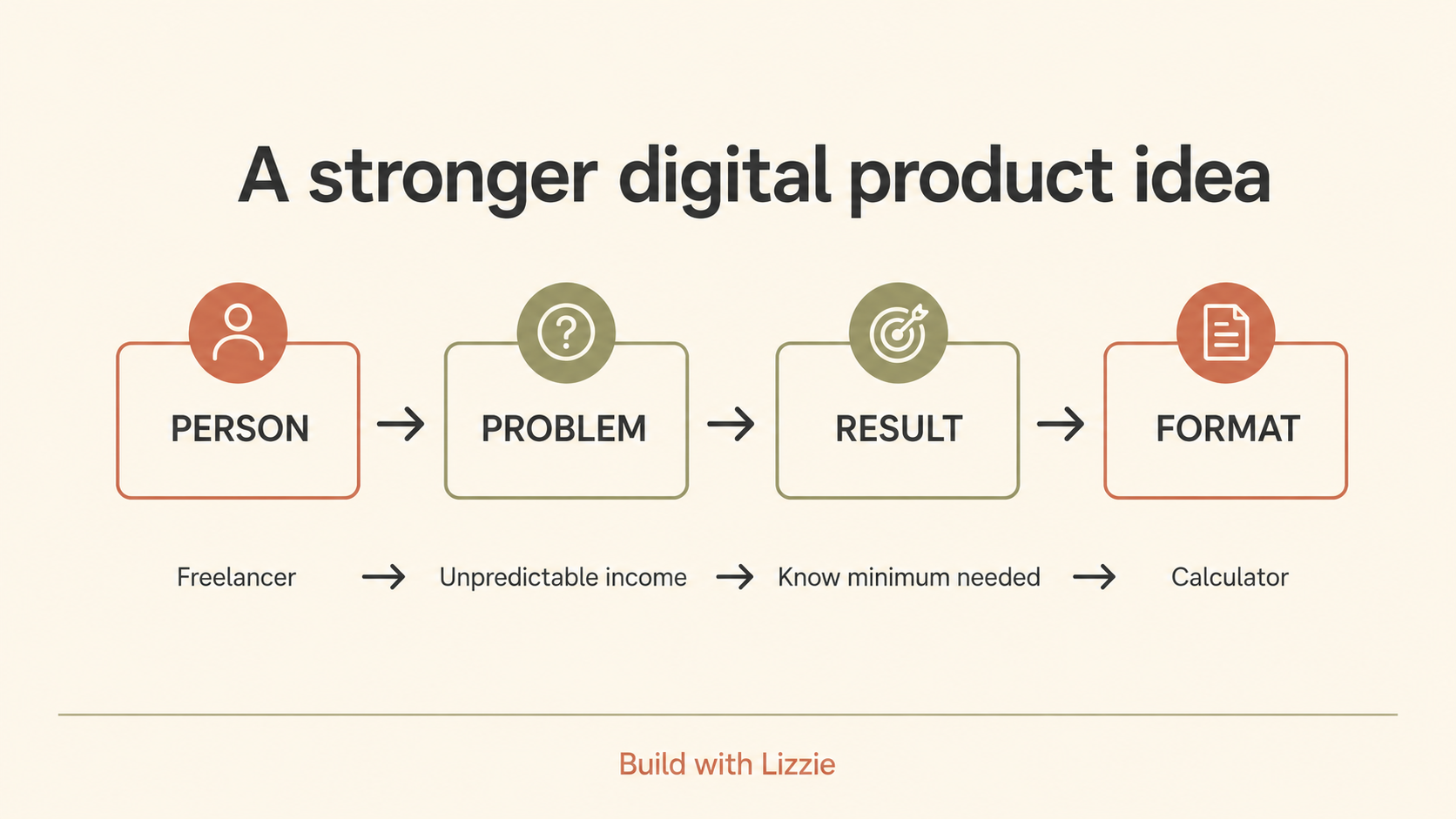
The stronger idea comes from combining:
Person + Problem + Useful Result + Format
For example:
Generic idea:
Budget spreadsheet
More specific idea:
Bare-Minimum Month Calculator for freelancers with unpredictable income
Or:
Generic idea:
Wedding planner
More specific idea:
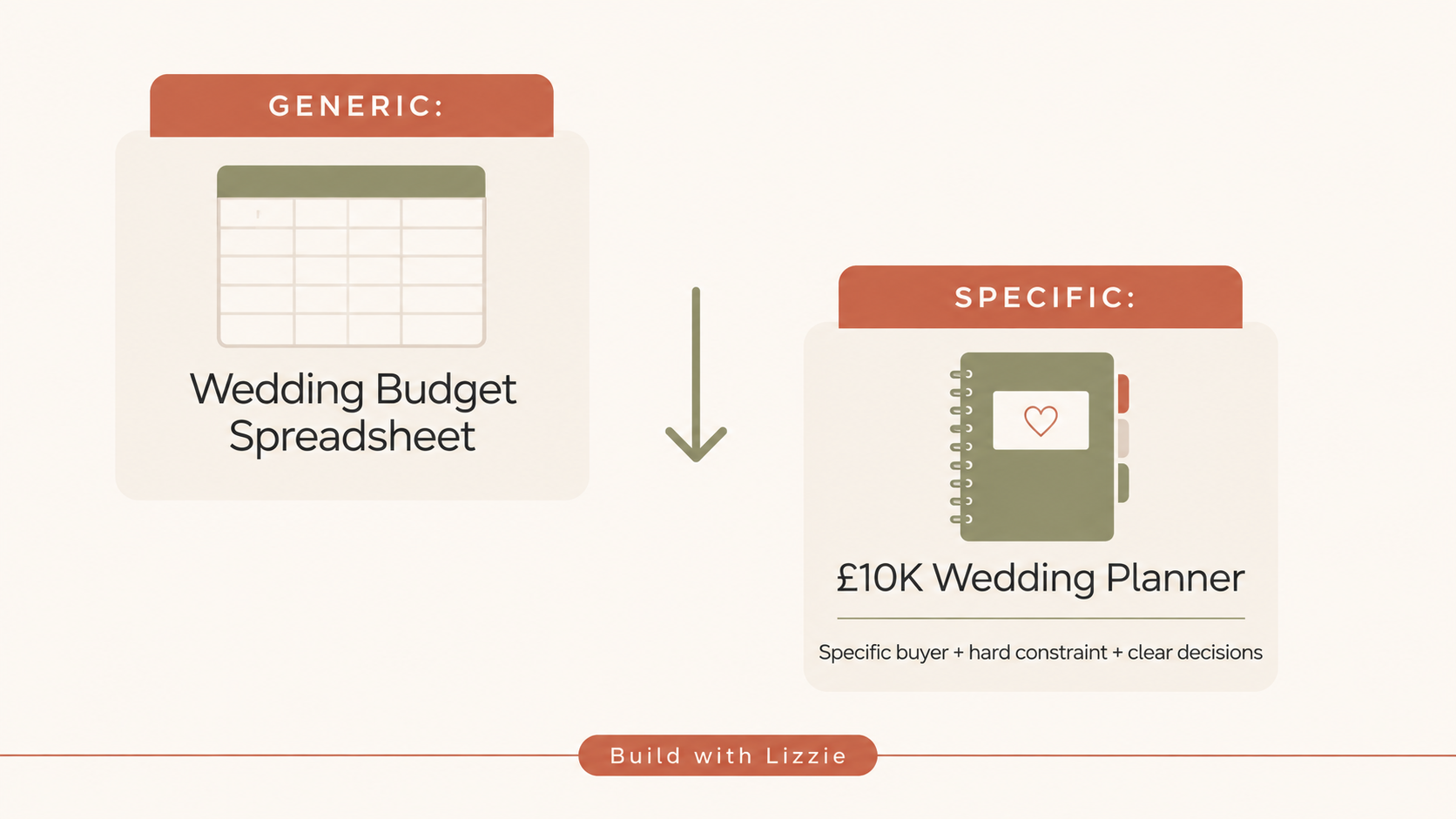
£10K Wedding Planner for couples trying to keep the full celebration under a fixed budget
Or:
Generic idea:
Meal planner
More specific idea:
15-Minute Weeknight Meal Planner for parents getting home late from work
The second versions are easier to understand because you can picture the person opening them.
You can also start imagining what needs to go inside.
1. Who do you actually understand?
You do not necessarily need to create a product for people exactly like you.
But it helps if you can understand the situation they are in.
Think about groups of people you already know something about.
That might include:
- teachers;
- parents;
- students;
- freelancers;
- dog owners;
- new managers;
- jobseekers;
- crafters;
- brides and grooms;
- first-time homeowners;
- travellers;
- small business owners;
- people learning a particular hobby.
You can also think about stages of life.
Someone planning their first wedding has different problems from someone organising a second marriage.
A first-time manager has different questions from someone who has managed a team for ten years.
A beginner runner needs something different from someone training for their fifth marathon.
Specificity helps.
A little exercise
Write down five groups of people you could imagine creating something for.
Then ask:
What do I already know about their day-to-day problems?
You are not looking for the group with the biggest possible audience.
You are looking for somewhere you can start understanding the problem properly.
I have found this much more useful than starting with:
What niche is trending?
Because trends can give you ideas.
Understanding gives you better products.
2. What problem are they actually trying to solve?
This is probably the most important question.
A product does not need to solve somebody's biggest life problem.
It can solve something surprisingly small.
The important part is that the problem is recognisable.
For example:
Weak:
Meal planner
Stronger:
A parent gets home from work at 6pm and cannot decide what to cook with the food already in the house.
That could become:
15-Minute Weeknight Meal Planner
Or:
Weak:
Pet tracker
Stronger:
A rescue dog owner wants one place to record eating, sleeping, behaviour and settling-in patterns.
That could become:
Rescue Dog Settling-In Tracker
Or:
Weak:
Wedding budget spreadsheet
Stronger:
A couple wants an elegant wedding but absolutely cannot let the total creep beyond £10,000.
That could become:
The £10K Wedding Planner
I actually explored this last example while experimenting with how far you can take a very generic product idea.
The interesting part was not changing the colours.
It was changing the question the product answered.
Instead of:
How much have we spent?
the useful questions became things like:
Will this push us over £10K?
How much headroom do we have?
What happens if supplier quotes rise?
What would 10 extra guests do to the budget?
That is when a generic tracker starts becoming a much more specific tool.
When you are evaluating your own idea, try finishing this sentence:
This product is for someone who struggles with __________.
If the answer is vague, keep digging.
3. What does the person want to know, do or decide?
This question has completely changed how I think about digital products.
Because a digital product does not always need to teach something.
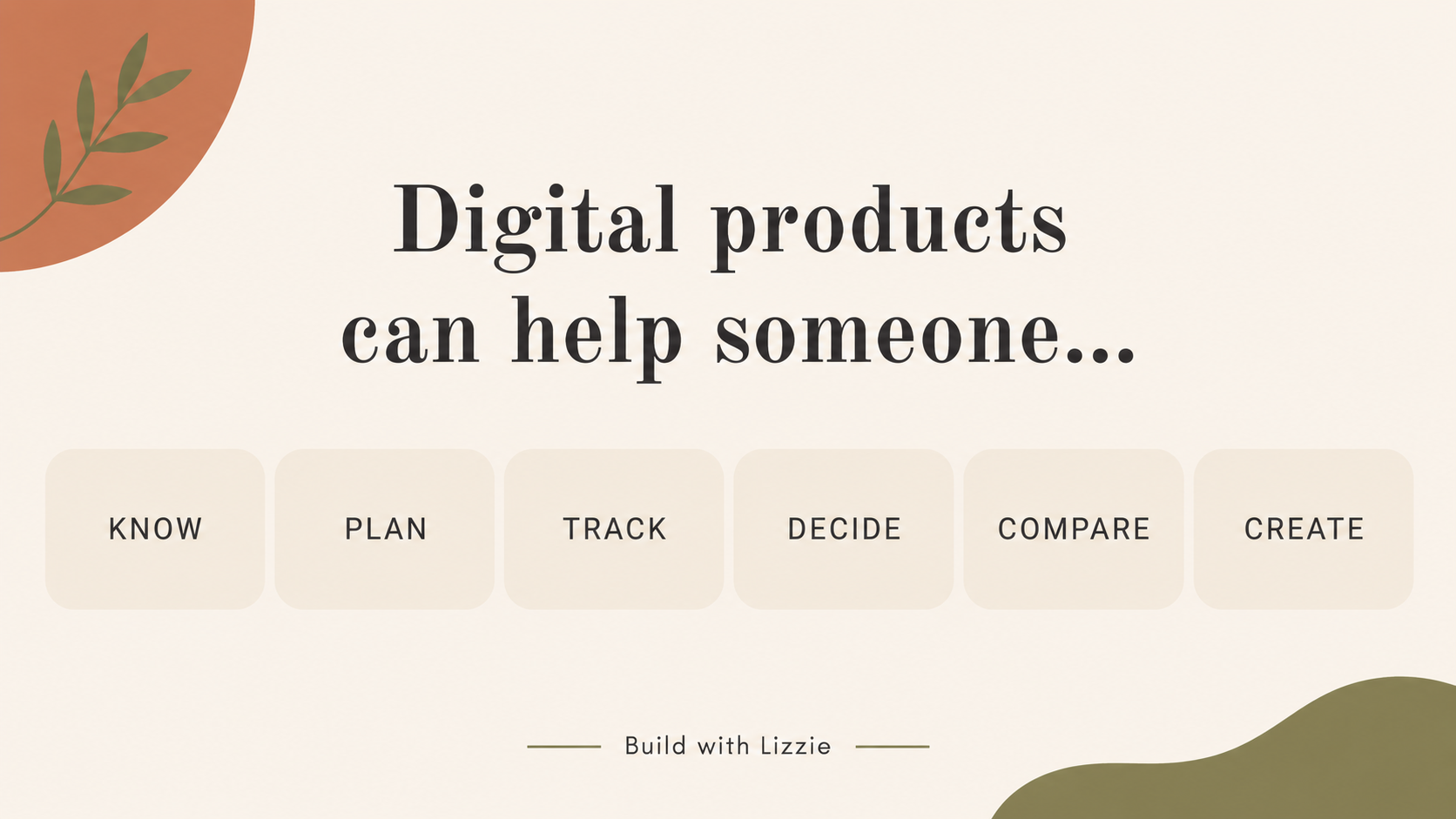
Sometimes it helps someone:
KNOW
How much money do I need this month?
DECIDE
Which wedding venue actually costs less once the extras are included?
PLAN
What do I need to study this week?
TRACK
Which mistakes do I keep making in practice exams?
ORGANISE
What meals are already in my freezer?
COMPARE
Which car will actually cost me less to own?
CREATE
What should I include in my client welcome email?
REVIEW
Which craft fair actually made me the most profit?
Those are all potential product jobs.
And once you know the job, choosing the format becomes much easier.
This is also where I think digital products become much more interesting than the usual “make an ebook” advice.
An ebook can be useful.
But sometimes nobody needs 70 pages of information.
They need a calculator that gives them a number.
Or a comparison table.
Or three templates.
Or a spreadsheet that finally keeps everything in one place.
4. What format actually suits the problem?
Now you can think about the product format.
Not before.
This sounds obvious when I write it down, but I have absolutely caught myself doing the opposite.
I like spreadsheets.
So sometimes my brain starts with:
What spreadsheet could I make?
Now I am trying to make the format earn its place.
Here is a simple guide.
If they need to calculate something...
Consider:
- spreadsheet;
- calculator;
- estimator;
- pricing tool;
- scenario planner.
Example: Custom Cake Quote Calculator
If they need to organise information...
Consider:
- tracker;
- database;
- dashboard;
- spreadsheet;
- inventory.
Example: Freezer Inventory and Meal Matcher
If they need to think something through...
Consider:
- workbook;
- guided journal;
- audit;
- assessment;
- decision worksheet.
Example: Career Change Evidence Workbook
If they repeat the same task...
Consider:
- template;
- swipe file;
- script pack;
- checklist;
- reusable workflow.
Example: Photography Client Email Template Pack
If they need to compare options...
Consider:
- comparison calculator;
- decision matrix;
- scorecard;
- quiz;
- recommendation tool.
Example: Wedding Venue Package Comparison Calculator
If they need to follow a sequence...
Consider:
- planner;
- roadmap;
- checklist;
- calendar;
- sprint system.
Example: 90-Day Wedding Planning Sprint
A lot of digital product ideas get stronger simply by changing the format.
Maybe your idea does not need to become an ebook.
Maybe it needs to become something the person can actually use while solving the problem.
5. Could you actually create a useful version?
Notice I did not say:
Are you the world's leading expert?
That is a very different question.
There are products you should not create without appropriate qualifications or reliable expert input.
Health, legal and financial advice deserve particular care.
But plenty of digital products are about:
- organisation;
- planning;
- reflection;
- templates;
- calculations based on user-entered information;
- compiling useful resources;
- making a process easier.
Ask yourself:
Do I understand the problem well enough to start?
Can I research what I do not know?
Can I test the product properly?
Can I verify important information?
Could I make a simple version that is genuinely useful?
AI can help enormously here.
I use AI to:
- generate possibilities;
- organise rough thoughts;
- suggest questions;
- brainstorm features;
- rewrite confusing instructions;
- create example data;
- challenge an idea;
- identify things I may have missed.
But I do not think the useful model is:
Ask AI to make a random product, upload it somewhere and hope for money.
That just makes it easier to create more stuff nobody asked for.
The advantage of AI is that we can create and test better ideas faster.
6. Can you actually reach the people who need it?
This is one I am thinking about a lot while building Build with Lizzie.
Because I do not want my business model to become:
Make something
↓
Upload it
↓
Cross fingers aggressively
Somebody still has to discover the thing.
So before investing loads of time, ask:
Where are people with this problem already looking for help?
Maybe it is:
- Pinterest;
- Google;
- Etsy;
- YouTube;
- Reddit;
- Facebook groups;
- professional communities;
- industry newsletters;
- Instagram;
- TikTok.
Search for the problem itself.
Look at what appears.
Look at autocomplete suggestions.
Read comments.
Read reviews of existing products.
Look at the phrases people naturally use.
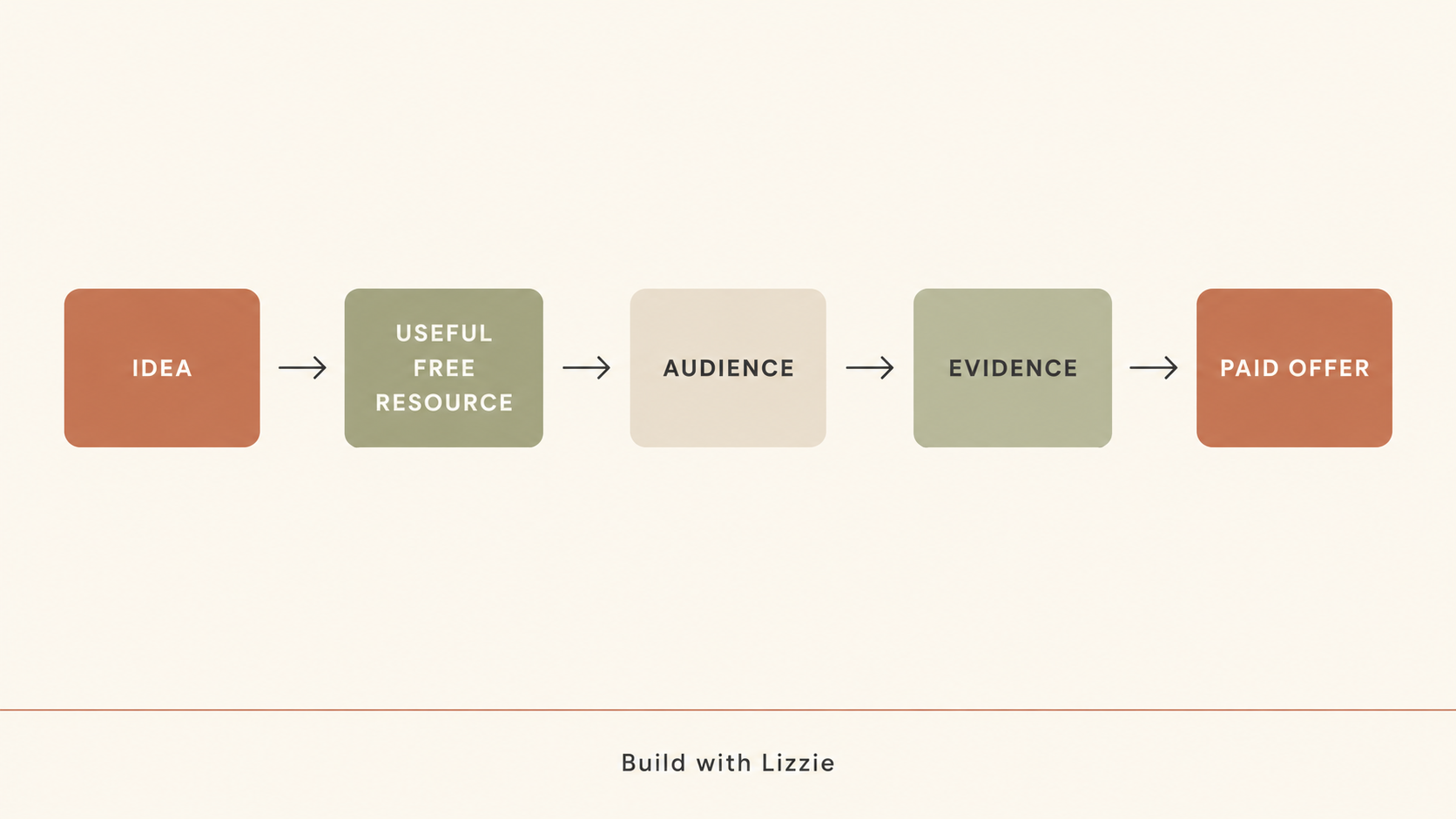
This is also why I am currently building my own business around content, useful free resources and an email list rather than trying to make a giant paid product immediately.
My current thinking is:
Find a useful problem
↓
Create something small around it
↓
Get it discovered
↓
See who responds
↓
Build an audience
↓
Learn what they want next
↓
Create the bigger paid solution from better evidence
I find that much less scary than trying to predict my perfect product before I have any information.
7. Could you test the idea before building the full product?
This might be the question that saves you the most time.
You do not always have to build the entire paid product first.
Imagine you want to eventually sell:
Complete Freelance Finance System
Instead of building the whole thing, you could first create:
Free Bare-Minimum Month Calculator
Then see:
Do people click?
Do people download it?
What do they ask afterwards?
What other money problems come up?
Or maybe the eventual product is:
Complete New Manager Toolkit
Your test could be:
Free First 1:1 Meeting Agenda
Or:
Complete Wedding Budget Planner
Your test could be:
Free Wedding Budget Health Check
Or:
ADHD-Friendly Planning System
Your test could be:
Free Task Friction Audit
You are not proving that the complete business will succeed.
You are gathering evidence that people care about the problem.
That is enough for the next decision.
So, what digital product should you sell?
At this point you may have three, five or fifteen possible ideas.
Good.
Do not try to decide purely on instinct.
Score them.
I use five simple questions:
I understand this audience
__/5
I understand the problem
__/5
I would enjoy creating this
__/5
I could reach these people
__/5
There are obvious related products
__/5
Total: __/25
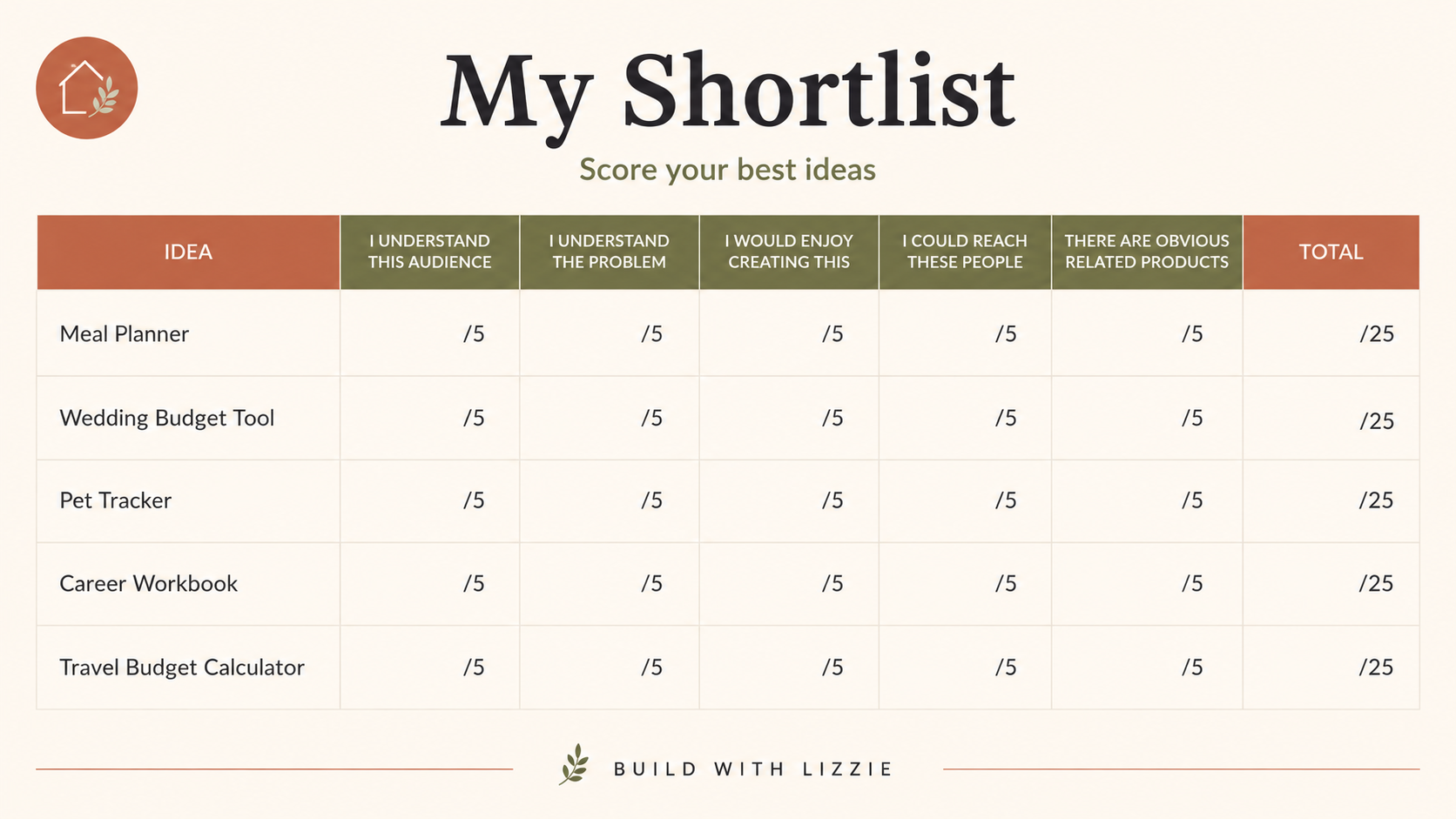
This is not some scientific formula that predicts whether you will make money.
It is simply a way to stop one exciting idea from running away with your entire weekend.
And I say that as someone whose brain is very capable of turning:
Hmm, that could be interesting.
into:
I have now designed nine tabs, chosen the brand colours and named the imaginary membership.
Sometimes we need a scoring system.
Don't choose your forever product
This is the part I want you to remember.
You are not choosing the product you have to sell forever.
You are choosing:
the idea worth investigating next.
That is much easier.
Pick one.
Search the problem.
Look at what already exists.
Read reviews.
Look for complaints.
Notice the words people use.
Think about how you could test interest.
Create something small if that makes sense.
Then learn.
If nobody cares, that is information.
If people respond strongly, that is information too.
You can move forward with much more confidence because the next decision is based on something real.
One final thought
AI has made creating things easier.
That is exciting.
But it also means the internet is going to get even more crowded with things that were easy to make.
I don't think the advantage will come from being able to create the most.
I think it will come from being better at noticing:
Who is this for?
What are they struggling with?
What would genuinely make that easier?
Then using AI to help you make that solution faster and better.
That is the approach I am trying to build Build with Lizzie around.
Not:
Create more stuff.
But:
Create more useful stuff, then pay attention to what happens.
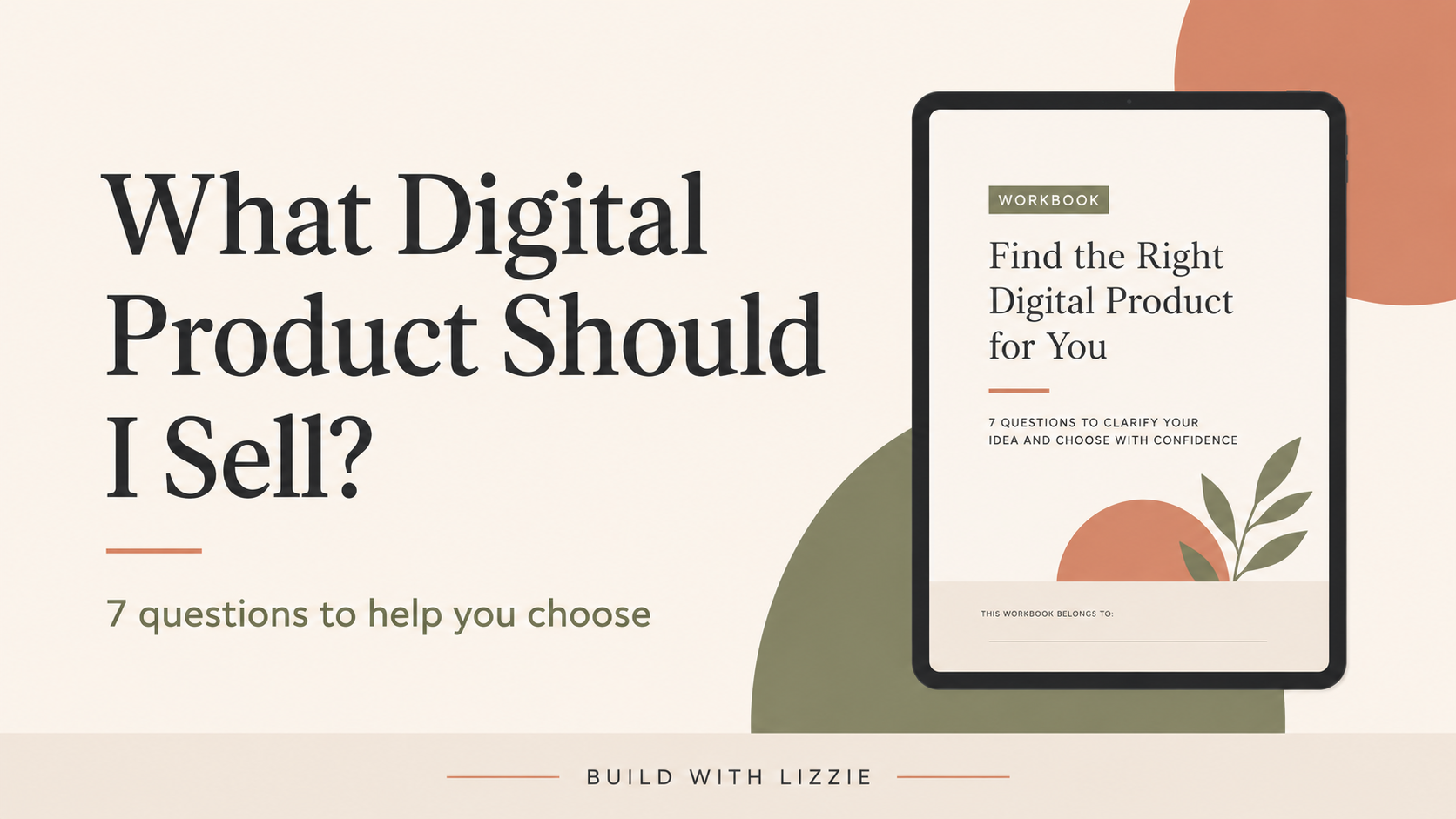
And if you do not know what useful thing to start with yet, that is exactly what the free workbook is there to help you figure out.